
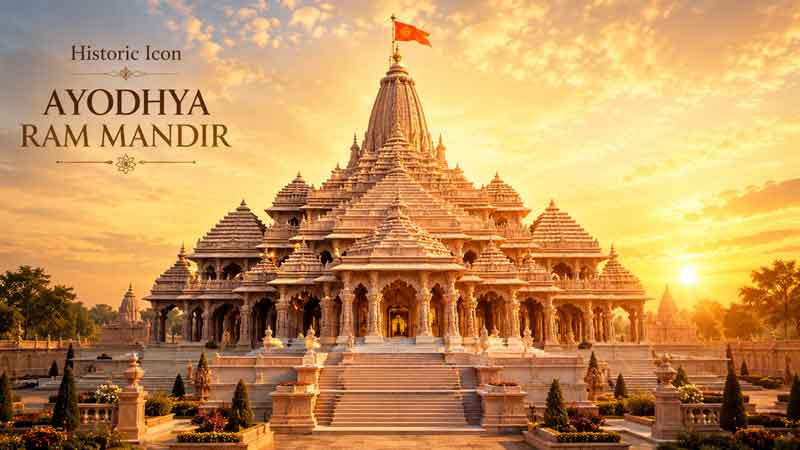
Historical and Religious Significance Ram Mandir
The historical and religious significance of the Ram Mandir is deeply rooted in Hindu mythology and history. Ayodhya, where the temple is located, is believed to be the birthplace of Lord Ram, a central figure in Hinduism. Here are some key aspects of the historical and religious significance of the Ram Mandir:
Birthplace of Lord Ram:
Ayodhya is traditionally considered the birthplace of Lord Ram, the seventh avatar of Lord Vishnu. According to the Hindu epic Ramayana, Lord Ram was born to King Dasharatha and Queen Kaushalya in Ayodhya. The site is believed to be the exact spot where Lord Ram was born, known as Ram Janmabhoomi.
Ramayana and Ayodhya:
The Ramayana, an ancient Indian epic, narrates the life and adventures of Lord Ram. The story revolves around his exile, the abduction of his wife Sita by the demon king Ravana, and the eventual triumph of good over evil. Ayodhya is depicted as the ideal city and the kingdom of Lord Ram.
Cultural and Spiritual Significance:
The Ram Mandir holds immense cultural and spiritual significance for Hindus. Lord Ram is revered as a symbol of dharma (righteousness) and the embodiment of ideal qualities, making Ayodhya and the Ram Mandir important pilgrimage sites for millions of devotees.
Historical Events and Ayodhya:
The history of Ayodhya has been marked by various rulers and kingdoms, including the Mughals. The construction of the Babri Masjid on the purported birthplace of Lord Ram in the 16th century became a source of historical and religious tension, culminating in the demolition of the mosque in 1992.
Babri Masjid and Controversy:
The Babri Masjid, built during the reign of Mughal Emperor Babur, was constructed on the site believed by Hindus to be the birthplace of Lord Ram. The mosque's presence on the sacred site became a focal point of a contentious dispute, leading to decades of legal battles and social tensions.
Legal Disputes and Supreme Court Verdict:
The legal battles over the ownership of the disputed site persisted for years, ultimately reaching the Supreme Court of India. The landmark verdict in 2019 granted the entire site to the Hindus, allowing for the construction of the Ram Mandir and allocating an alternative piece of land for the construction of a mosque.
National Symbolism:
The Ram Mandir is considered a symbol of national and cultural identity by many Hindus. Its construction has been viewed as a momentous event in the history of independent India, representing the assertion of cultural heritage and religious sentiments.
Babri Masjid and Demolition:
The Babri Masjid, located in Ayodhya, Uttar Pradesh, India, was a mosque that became the center of a long-standing and contentious dispute between Hindus and Muslims. The controversy was primarily focused on the belief that the mosque was built on the site regarded by Hindus as the birthplace of Lord Ram. Here's an overview of the Babri Masjid and the events leading to its demolition:
Construction of the Babri Masjid:
The Babri Masjid was constructed in Ayodhya during the rule of the Mughal Emperor Babur in the early 16th century. It was built in the Indo-Islamic architectural style and became a prominent mosque in the region.
Hindu Belief in the Ram Janmabhoomi:
According to Hindu tradition, the Babri Masjid was believed to have been built on the exact spot where Lord Ram, a significant deity in Hinduism, was born. The location is known as Ram Janmabhoomi, and it has been considered sacred by Hindus for centuries.
Emergence of the Ayodhya Dispute:
The dispute over the Babri Masjid and the Ram Janmabhoomi site became a major point of contention between Hindus and Muslims. Attempts to resolve the issue through negotiations and legal means were largely unsuccessful, leading to heightened tensions.
Ram Janmabhoomi Movement:
The 1980s witnessed the rise of the Ram Janmabhoomi movement, a political and social campaign advocating for the construction of a temple at the site believed to be Lord Ram's birthplace. The movement gained significant momentum and support from various Hindu organizations.
Demolition of the Babri Masjid (December 6, 1992):
On December 6, 1992, a large gathering of Hindu activists, including members of various right-wing groups, gathered at the Babri Masjid site. The situation escalated, and the mosque was eventually demolished by the crowd. The demolition led to widespread communal violence and tension across India.
Aftermath and Legal Proceedings:
The demolition of the Babri Masjid resulted in nationwide protests, communal riots, and a significant impact on the social and political fabric of India. Various legal cases were initiated in the aftermath of the demolition.
Land Dispute and Supreme Court Verdict:
The legal battle over the ownership of the disputed site continued for years. The case reached its culmination with the Supreme Court of India's verdict on November 9, 2019. The court awarded the entire disputed land to the Hindus for the construction of the Ram Mandir and allocated an alternative piece of land for the construction of a mosque
Legal Battles
The legal battles surrounding the Babri Masjid-Ram Janmabhoomi dispute spanned several decades and were marked by numerous legal proceedings in various courts. The complex nature of the case involved multiple parties, including Hindu and Muslim religious organizations, as well as historical and archaeological perspectives. Here's an overview of the key legal battles:
Initial Legal Disputes:
The legal disputes over the Babri Masjid-Ram Janmabhoomi issue date back to the mid-19th century. However, the modern legal proceedings gained prominence in the 20th century.
1949: Idol Installation and Locking of the Mosque:
In 1949, idols of Lord Ram appeared inside the central dome of the Babri Masjid, leading to tensions. The mosque was subsequently locked, and the site became a subject of legal disputes.
1950s-1960s: Civil Suits and Legal Battles Begin:
Various civil suits were filed in the 1950s and 1960s by both Hindu and Muslim parties claiming ownership of the site. These legal battles marked the beginning of the protracted legal process.
1986: Shah Bano Case and Opening of the Lock:
In 1986, the gates of the locked mosque were opened by a district judge, allowing Hindus to worship inside the disputed structure. The same year, the controversial Shah Bano case led to increased communal tensions.
1989: Land Title Suit Filed:
In 1989, a formal title suit was filed by a Hindu deity (represented by the deity's "next friend") in the Allahabad High Court, seeking ownership of the entire disputed land. The Sunni Waqf Board and the Nirmohi Akhara also filed separate suits.
1992: Demolition and Legal Fallout:
The demolition of the Babri Masjid on December 6, 1992, had profound legal repercussions. Criminal and civil cases were filed against various individuals and organizations involved in the demolition.
Allahabad High Court Verdict (2010):
The Allahabad High Court delivered its verdict on September 30, 2010. The court divided the disputed land into three parts, with one-third going to each of the three main litigants: the Sunni Waqf Board, the Nirmohi Akhara, and the party representing the deity Lord Ram.
Supreme Court of India (2019):
The case reached its final stage in the Supreme Court of India. The court conducted daily hearings and, on November 9, 2019, delivered a historic verdict. The court awarded the entire disputed land to the Hindus for the construction of the Ram Mandir and provided an alternative piece of land to the Sunni Waqf Board for the construction of a mosque.
The legal battles over the Babri Masjid-Ram Janmabhoomi dispute have been central to discussions on religious freedom, property rights, and communal harmony in India. The resolution of the case by the Supreme Court in 2019 marked a significant milestone, providing a legal conclusion to one of the most contentious and prolonged disputes in Indian history.
Supreme Court Verdict:
The Supreme Court of India delivered a historic verdict on the Babri Masjid-Ram Janmabhoomi dispute on November 9, 2019. The verdict was the culmination of a legal battle that had spanned several decades and had significant implications for the religious and social landscape of India. Here are the key aspects of the Supreme Court verdict:
Land Ownership:
The Supreme Court unanimously ruled that the disputed land, where the Babri Masjid once stood, should be handed over to the Hindus for the construction of a temple dedicated to Lord Ram. The court acknowledged the historical and religious significance of the site for the Hindu community.
Alternative Land for the Mosque:
The court directed the central government to allocate a five-acre plot of land at a prominent location in Ayodhya to the Sunni Waqf Board for the construction of a mosque. This provision aimed to ensure that both Hindus and Muslims had a space for worship.
Legal Basis of the Decision:
The Supreme Court based its decision on a comprehensive evaluation of historical, archaeological, and legal evidence. The court considered the faith and belief of the Hindu community regarding the birthplace of Lord Ram as well as the evidence presented by archaeologists indicating the presence of a pre-existing structure beneath the Babri Masjid.
Unity in Diversity:
The court emphasized the secular fabric of the Indian Constitution and the importance of maintaining unity in diversity. It highlighted the need for mutual respect and tolerance among different religious communities.
Justice S.A. Bobde's Remarks:
Chief Justice Ranjan Gogoi, who led the five-judge bench, stated in the verdict that the court aimed to balance the faith and beliefs of both communities while adhering to legal principles. Justice S.A. Bobde, who succeeded Justice Gogoi, emphasized that the judgment was not based on faith or belief but on the rule of law.
Public Reaction:
The verdict was met with diverse reactions. While some welcomed the decision as a resolution to a longstanding dispute, others expressed concerns about the implications for religious freedom and the potential for communal tensions.
Implementation of the Verdict:
The Indian government formed a trust called the Shri Ram Janmabhoomi Teerth Kshetra for the construction of the Ram Mandir. The trust oversees the temple's construction and associated activities.
The Supreme Court's verdict marked a significant moment in India's legal and social history, providing a legal resolution to a deeply contentious issue. The decision aimed to strike a balance between faith and the rule of law, and its implementation has been a focal point in discussions about religious harmony and coexistence in India.
Construction Commencement:
The construction of the Ram Mandir in Ayodhya officially commenced with a groundbreaking ceremony held on August 5, 2020. The event was a significant and symbolic moment, attended by various political leaders, religious figures, and thousands of devotees. Here are key details about the commencement of the construction:
Date of Groundbreaking Ceremony:
The groundbreaking ceremony for the construction of the Ram Mandir took place on August 5, 2020. This date holds special significance as it coincides with the first anniversary of the abrogation of Article 370 and the bifurcation of Jammu and Kashmir into two union territories.
Participants in the Ceremony:
The ceremony was attended by a select group of dignitaries, including Prime Minister Narendra Modi, members of the Ram Janmabhoomi Teerth Kshetra Trust, saints, and religious leaders. The guest list was limited due to the COVID-19 pandemic, but the event was broadcasted widely.
Rituals and Religious Observances:
The groundbreaking ceremony included various rituals and religious observances. The prime minister laid the foundation stone for the temple, and soil from different parts of the country was used in the construction, symbolizing the unity and diversity of India.
Design and Architecture:
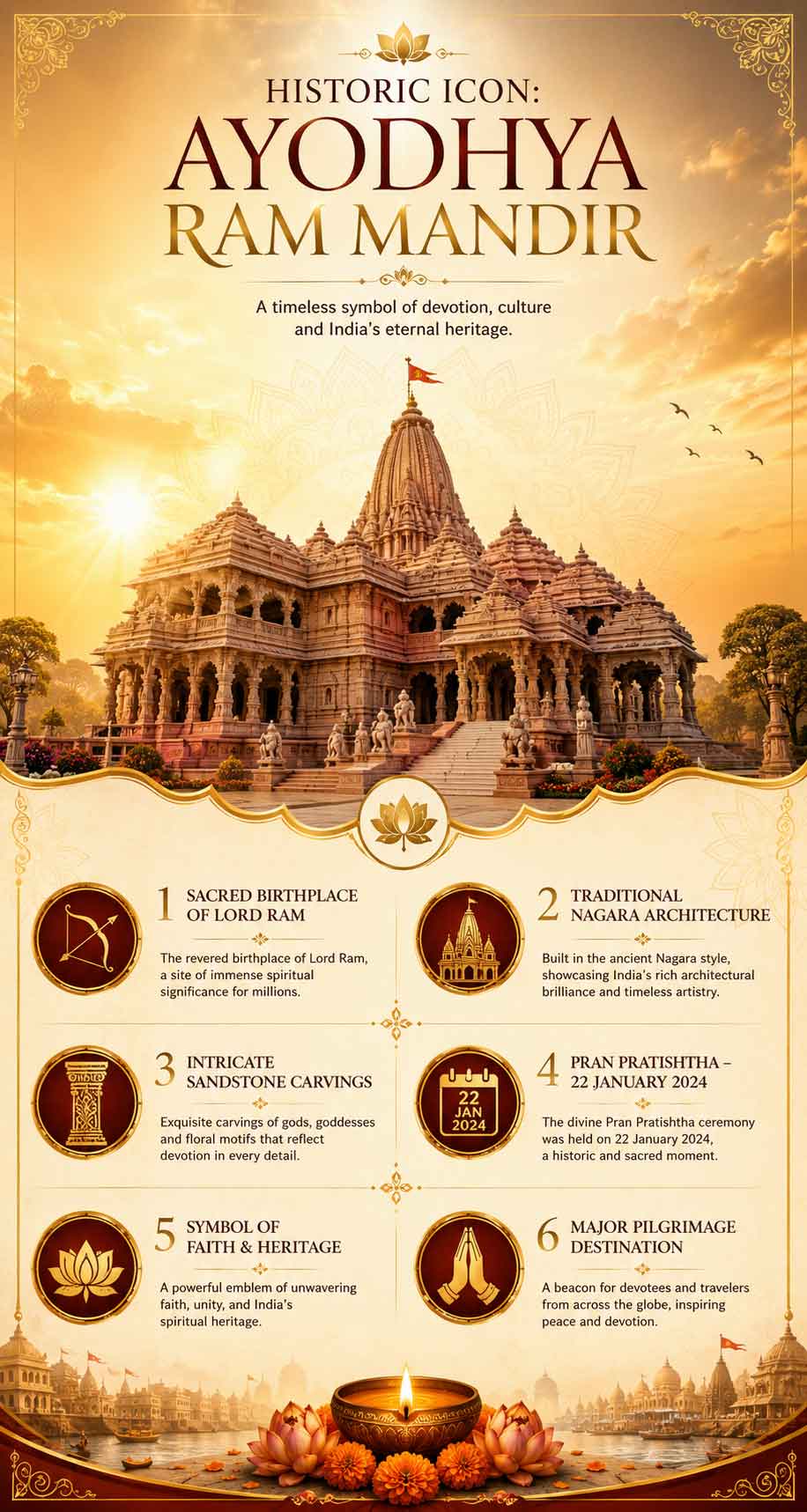
The proposed design of the Ram Mandir draws inspiration from traditional North Indian temple architecture. The temple is planned to have a grand sanctum sanctorum with a central dome and two smaller domes, reflecting the style of ancient Indian temples. The architecture is expected to showcase intricate carvings and sculptures depicting episodes from the Ramayana.
Symbolic Importance:
The commencement of the Ram Mandir's construction is seen as a realization of a long-standing dream for millions of Hindus who considered Ayodhya as the birthplace of Lord Ram. The ceremony marked the beginning of the physical manifestation of their faith and devotion.
National and International Attention:
The event garnered attention not only within India but also internationally. The construction of the Ram Mandir is a significant cultural and religious development with implications for India's diverse societal fabric.
Implementation of Supreme Court Verdict:
The construction of the Ram Mandir was in line with the Supreme Court's November 2019 verdict, which granted the entire disputed land to the Hindus for the construction of the temple. The ceremony marked the practical implementation of the court's decision.
The groundbreaking ceremony for the Ram Mandir was a momentous occasion, and the construction of the temple continues to be a significant cultural and religious project. It has evoked a range of sentiments and discussions about religious harmony, cultural identity, and the coexistence of diverse beliefs in India.
Architectural Features:
The architectural features of the Ram Mandir in Ayodhya are inspired by traditional North Indian temple architecture and are designed to reflect the grandeur and symbolism associated with Lord Ram and the Ramayana. While the specific architectural details may evolve during the construction process, here are some anticipated features based on proposed designs and architectural concepts
Central Sanctum Sanctorum:
The temple is expected to have a grand central sanctum sanctorum (garbhagriha) where the main deity, Lord Ram, will be enshrined. This central chamber is the holiest part of the temple and is often adorned with intricate carvings and sculptures depicting scenes from Hindu mythology.
Dome(s):
The proposed design includes a central dome over the sanctum sanctorum, which is a common feature in many Hindu temples. Additionally, there may be smaller domes situated over other significant areas of the temple complex, adding to its architectural elegance.
Mandapa (Assembly Hall):
The temple complex may feature a mandapa or assembly hall where devotees can gather for prayers and religious ceremonies. The mandapa typically has pillars and intricate carvings, serving as a space for spiritual congregation and rituals.
Carvings and Sculptures:
One of the distinguishing features of the Ram Mandir's architecture is expected to be the intricate carvings and sculptures adorning the temple walls, pillars, and ceilings. These carvings may depict scenes from the Ramayana, showcasing the life and adventures of Lord Ram, as well as other deities and mythological figures.
Murtis (Idol Statues):
The temple may house various murtis or idol statues of Hindu deities, saints, and mythological characters. These statues are often made from stone or metal and are intricately crafted to embody the divine qualities of the respective deities.
Traditional Elements:
The architectural design may incorporate traditional elements such as shikhara (tower), kalasha (pinnacle), gopuram (ornate entrance gateway), and mandapams (pillared halls). These elements are characteristic of North Indian temple architecture and add to the temple's aesthetic appeal and religious significance.
Materials Used:
The temple is likely to be constructed using traditional building materials such as stone, marble, and sandstone. These materials are durable and have been traditionally used in the construction of Hindu temples, lending a timeless quality to the architectural design.
Cultural and Social Impact
The construction of the Ram Mandir in Ayodhya has had a profound cultural and social impact in India, touching upon various aspects of society, politics, and identity. Here are some key points highlighting the cultural and social impact of the Ram Mandir
Religious Symbolism
The Ram Mandir holds immense religious significance for Hindus, as it is believed to be the birthplace of Lord Ram, a central figure in Hindu mythology. Its construction fulfills a long-standing aspiration of millions of Hindus who consider Ayodhya as a sacred pilgrimage site.
Cultural Heritage
The Ram Mandir represents an embodiment of India's cultural heritage and historical continuity. Its construction draws from traditional North Indian temple architecture, showcasing the country's rich architectural and artistic traditions.
Unity and Integration
The construction of the Ram Mandir has been hailed by many as a unifying force that bridges religious divides and fosters a sense of national integration. It symbolizes the coming together of diverse communities to celebrate a shared cultural legacy.
Political Ramifications
The Ram Mandir has been a politically charged issue in India for decades, with various political parties and groups leveraging it for electoral gains. Its construction has influenced political discourse and alliances, shaping the dynamics of Indian politics.
Legal Precedent
The legal battles surrounding the Babri Masjid-Ram Janmabhoomi dispute and the subsequent Supreme Court verdict have set important legal precedents in India. The resolution of the dispute through the judicial process has reaffirmed the country's commitment to the rule of law and constitutional principles.
Communal Harmony
While the construction of the Ram Mandir has been celebrated by Hindus, it has also raised concerns about communal harmony and religious tolerance. Efforts to ensure inclusivity and dialogue between different religious communities have been emphasized to mitigate potential tensions.
Tourism and Economy
The Ram Mandir is expected to become a major pilgrimage and tourist destination, attracting devotees and visitors from across India and around the world. This influx of tourists is likely to have a positive impact on the local economy and tourism infrastructure in Ayodhya.
International Perception
The construction of the Ram Mandir has garnered international attention, with observers analyzing its implications for religious freedom, secularism, and interfaith relations in India. It has sparked conversations about the complexities of managing religious diversity in a pluralistic society.
Pilgrimage Destination
The Ram Mandir in Ayodhya is expected to become a significant pilgrimage destination for millions of Hindus from across India and around the world. Here are several reasons why the Ram Mandir is anticipated to attract a large number of devotees
Religious Significance
Ayodhya is believed to be the birthplace of Lord Ram, a revered deity in Hinduism. The construction of the Ram Mandir at this sacred site fulfills a long-standing religious aspiration for Hindus, who consider it a place of immense spiritual importance.
Pilgrimage Tradition
Ayodhya has been a prominent pilgrimage destination for centuries, with devotees visiting the city to pay homage to Lord Ram and other associated deities. The completion of the Ram Mandir adds a new dimension to Ayodhya's pilgrimage tradition, attracting devotees eager to worship at the temple.
Historical and Cultural Heritage
The Ram Mandir represents India's rich historical and cultural heritage, as it is constructed on a site with deep-rooted historical significance. Pilgrims visiting the temple will have the opportunity to immerse themselves in the cultural legacy associated with Lord Ram and the Ramayana.
Architectural Splendor
The architectural design of the Ram Mandir is expected to be awe-inspiring, featuring traditional North Indian temple architecture with intricate carvings and sculptures depicting scenes from the Ramayana. Pilgrims will be drawn to the temple's architectural splendor and craftsmanship.
Spiritual Experience
For many Hindus, visiting sacred sites like the Ram Mandir is a deeply spiritual experience. Pilgrims seek blessings, perform religious rituals, and participate in prayers and ceremonies, fostering a sense of spiritual connection with their faith and deity.
Community and Festivals
Pilgrimage to the Ram Mandir offers devotees the opportunity to connect with like-minded individuals and participate in religious festivals and celebrations. The temple complex is expected to host various events and religious gatherings, creating a sense of community among pilgrims.
Tourism and Infrastructure
The development of tourism infrastructure in Ayodhya, including accommodation facilities, transportation services, and pilgrimage amenities, will support the influx of pilgrims visiting the Ram Mandir. Local authorities and businesses are expected to cater to the needs of pilgrims, enhancing their pilgrimage experience.
Leave a comment